
URGENT: Haryana Medical Council Names 8 Foreign Medical Universities as Non-Compliant — Every Indian MBBS Family Must Read This Now
Haryana Medical Council MBBS abroad warning 2026
Your child’s medical degree could be worthless before they even graduate. Here is what the official notice says — and what every family must do immediately.
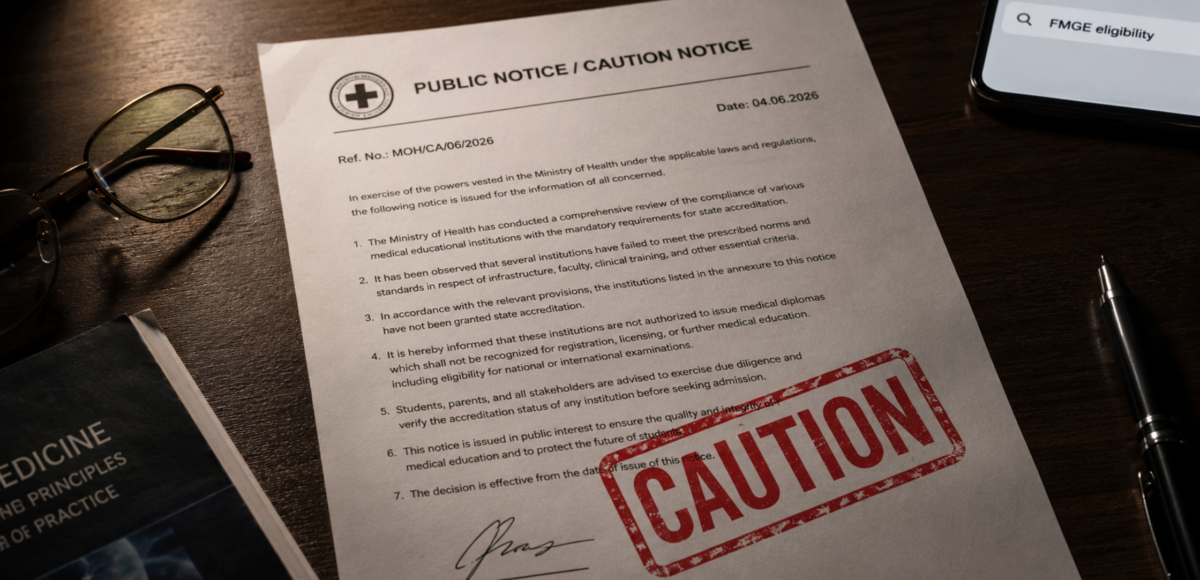
On June 9, 2026, the Haryana Medical Council (HMC) issued Public Notice / Caution Notice HMC/2026/303 — a formal, signed public advisory directed at students, parents, and the general public. Issued by Dr. Mandeep Kumar Sachdeva, Registrar, Haryana Medical Council, this notice is not a rumour. It is not a social media post. It is a government-issued public caution that carries the full authority of the State Medical Council of Haryana.
In twenty years of working in overseas medical education, I have seen advisories come and go. But when a State Medical Council issues a formal public notice naming eight specific institutions as non-compliant, and reinforces it with references to the National Medical Commission’s own alert notices — that is a moment where every family in India needs to stop, read, and act.
At Neolife Education, we are publishing this article with one purpose: to make sure that no Indian student or family makes an irreversible decision without knowing these facts.
What the Haryana Medical Council Notice Actually Says
The notice — reference HMC/2026/303, dated 09.06.2026 — is issued in continuation of two prior NMC Alert Notices:
- Alert Notice No. U-15021/1/2024-UGMEB (8264469) dated 21.07.2025
- And the subsequent advisory dated 01.04.2026
Both issued by the National Medical Commission.
The HMC notice states that certain foreign medical institutions have been found non-compliant with the prescribed norms and regulations, including specifically the Foreign Medical Graduate Licentiate (FMGL) Regulations, 2021 — the regulatory framework that governs whether an Indian student who studies MBBS abroad can legally practice medicine in India.
The consequences the notice identifies are severe, explicit, and cannot be understated:
- Non-recognition of medical qualification in India
- Ineligibility for registration with the NMC or State Medical Councils
- Disqualification from appearing in licensing examinations including FMGE and NExT
- Inadequate clinical training
- Financial and academic loss
This is not a warning about administrative paperwork. This is a warning that your child could spend six years and ₹30–60 Lakhs studying medicine at one of these institutions — and come back to India legally unable to practice medicine. Unable to register. Unable to sit the FMGE. Unable to work as a doctor. Anywhere in India.
The 8 Institutions Named in the Official Notice
The following eight institutions are explicitly named in HMC/2026/303 as non-compliant:
Belize (3 institutions):
- Central American Health and Sciences University, Belize
- Columbus Central University, Belize
- Washington University of Health and Sciences, Belize
Uzbekistan (4 institutions + 1 offshore campus): 4. Chirchik Branch of Tashkent State Medical University, Uzbekistan 5. Bukhara State Medical Institute (BSMI), Uzbekistan 6. Samarkand State Medical University (SSMU), Uzbekistan 7. Tashkent State Medical University (TSMU), Uzbekistan 8. TIT Institute of Medical Sciences, Bangalore — operating as the offshore campus of TSMU Uzbekistan
If your child is enrolled at, or considering applying to, any of these eight institutions — this changes everything you thought you knew about their plan.
Why Uzbekistan? Understanding the Pattern Behind the Warning
For anyone following the MBBS abroad landscape, the Uzbekistan warnings have been building for over a year. The NMC’s April 2026 advisory revealed the full picture — and it is deeply concerning.
The National Medical Commission issued a high-priority advisory cautioning Indian students against fraudulent practices and sub-standard medical education in Uzbekistan, following serious concerns flagged by the Embassy of India in Tashkent regarding declining standards and malpractices by recruitment agents.
The specific problems are not abstract. They are daily realities affecting students who are already enrolled:
Reports indicate that students are admitted beyond the intake capacity of the medical institute, compromising the quality of medical education. Students are not receiving hands-on training owing to lack of communication as the medium of instruction is not English language, making it challenging for Indian students.
Think about what that means practically. Your child paid full tuition for an “English-medium MBBS.” They arrived and discovered that the faculty teaches in Uzbek or Russian. The clinical training they were promised — the hands-on hospital rounds that will determine whether they can pass FMGE and become a competent doctor — is not happening. They are sitting in overcrowded classrooms, in a language they do not understand, with a university that has admitted far more students than its infrastructure can handle.
Indian medical students at Samarkand State Medical University in Uzbekistan have alleged lack of transparency, poor academic quality and unsafe living conditions on the campus, which led the Indian Embassy in Tashkent to issue an advisory and demand accountability from the university.
These are not allegations. These are documented complaints, verified by the Indian Embassy in Tashkent, escalated to the NMC, and now reinforced by a State Medical Council public notice. The institutional trail of evidence is unambiguous.
The Offshore Campus Problem — Why TIT Bangalore Is on the List
One of the most alarming entries on the HMC list is number eight: TIT Institute of Medical Sciences, Bangalore — identified as an offshore campus of TSMU Uzbekistan. This is significant for a reason that many families may not immediately recognise.
An Indian student might think: “I am studying at a Bangalore institution. I am in India. This must be safe.” It is not. The NMC also red-flagged TIT Institute of Medical Sciences in Bengaluru, which has been operating as an offshore campus for the TSMU Termez Branch (Uzbekistan).
Under FMGL Regulations 2021, a student studying MBBS through an offshore campus model — where part of their education happens in India and part abroad — may face serious compliance issues. To become eligible for medical registration in India, students must meet FMGL criteria including a minimum 54 months of education in a single institution, completion of a 12-month internship at the same university, and clinical training must not be split across countries. Failure to meet these requirements may result in disqualification from practicing medicine in India.
A student who studies through TIT Bangalore’s offshore arrangement may complete their course, receive a diploma — and then discover at the registration stage that their education structure does not comply with Indian licensing requirements. Six years. Potentially ₹40–60 Lakhs. And no license to practice.
What the HMC Notice Is Telling You to Do — The 6 Official Advisories
The notice does not only name the problem institutions. It provides six specific, actionable advisories that every family must follow:
1. Do not fall for fraudulent offers. No institution — regardless of what any agent, website, or WhatsApp forward claims — can guarantee admission outside the prescribed NEET qualification process. If someone is promising you an MBBS seat without proper NEET scores or without following NMC procedures, walk away.
2. Verify before making any payment. Before paying any fee — registration fee, admission fee, visa fee, hostel deposit — verify that the institution is duly recognised and compliant with FMGL Regulations 2021. Verification after payment is too late.
3. Check recognition and compliance. The HMC notice specifically says to verify the recognition status of foreign medical universities and ensure adherence to FMGL Regulations 2021. Check the university listing at wdoms.org (WHO World Directory of Medical Schools) and cross-reference with the NMC’s official list at nmc.org.in. Both must confirm compliance.
4. Avoid unverified agents. This is the advisory that should make every family reconsider who they are working with. Unauthorised and unverified agents or intermediaries for securing admission are explicitly warned against. An agent with no direct university contract, no NMC verification process, and no accountability structure is precisely the kind of intermediary this notice is addressing.
5. Seek official guidance. The HMC recommends consulting the National Medical Commission and Indian diplomatic missions abroad, wherever necessary. This is the standard of due diligence expected before making this decision.
6. Report suspicious activities. Any institution or individual offering illegal or misleading medical admissions should be reported to the National Medical Commission. If you have been approached by an agent making promises that sound too good to be true — they almost certainly are.
What This Means for Your MBBS Decision in 2026
The Haryana Medical Council notice, combined with the NMC’s April 2026 advisory and the Kyrgyzstan accreditation crisis of June 2026, creates a clear picture. The landscape of MBBS abroad is changing — and the regulatory net is tightening significantly.
This is not bad news for every family. It is bad news specifically for families who were considering non-compliant institutions. For families working with professional, verified consultancies at accredited universities, these advisories only confirm what good consultants already knew: that choosing the right institution and the right guidance partner is not a luxury. It is a career-defining, life-defining necessity.
Countries and institutions that are NOT named in the HMC notice and continue to offer safe, NMC-compliant MBBS pathways:
- Russia — Government medical universities like Kirov State Medical University, Kazan, Volgograd, established 40–60 years, NMC approved, WHO listed, English-medium, ₹30–32L total
- Philippines — UV Gullas, AUF, and other NMC-approved institutions with high patient-inflow hospitals and strong FMGE records
- Kazakhstan — Almaty-based medical universities with NMC compliance and established Indian student communities
These are destinations where Neolife Education has direct university contracts, on-ground support teams, and verified compliance monitoring — not annual compliance, but continuous oversight.
The Questions Every Parent Must Ask Before Enrolling
Before committing to any university abroad for MBBS, ask your consultant these six questions. If they cannot answer all six with documented evidence — do not proceed:
- Is this university listed on WDOMS (wdoms.org) with a current, active status?
- Is this university listed on the NMC’s approved foreign institutions list at nmc.org.in?
- Has the NMC issued any advisory, notice, or alert about this university or country in the last 24 months?
- Does your consultancy hold a direct contract with this university, or are you a sub-agent or associate?
- What is this university’s FMGE pass rate for Indian graduates over the last 3 years?
- Is the medium of instruction genuinely English — not marketed as English but delivered in another language?
A professional, experienced consultancy will answer all six questions with confidence and documentation. An unverified agent will deflect, dismiss, or simply not know.
Neolife Education’s Response to the HMC Notice
At Neolife Education, we have reviewed the HMC/2026/303 notice in full. We confirm that none of the eight institutions named in the notice are or have ever been recommended or processed by Neolife Education.
Our verification protocol for every university we recommend includes:
- WDOMS listing check (current status)
- NMC compliance verification (ongoing, not one-time)
- Direct university contract (not sub-agent arrangement)
- On-ground team presence in the destination country
- FMGE pass rate review for Indian graduates
This notice is not a shock to us. It is a confirmation of what disciplined, professional consultancy has always required: rigorous, independent verification of every university we place students in.
Frequently Asked Questions
Q: My child is already enrolled at one of the 8 named institutions. What should they do? A: Do not panic and do not leave immediately. Contact the NMC directly at nmc.org.in, and contact a professional MBBS consultancy to explore transfer options to NMC-compliant universities. Transfer pathways exist and have been used successfully. Act quickly but act informed.
Q: Does being named in the HMC notice automatically mean an institution has lost NMC recognition? A: Not necessarily in every case. The notice flags institutions as non-compliant with FMGL Regulations 2021. This means students enrolling at these institutions face significant risk of non-recognition of their degree, ineligibility for FMGE, and inability to practice in India. The risk is real, serious, and documented.
Q: Is all MBBS in Uzbekistan now unsafe? A: No. The specific institutions named are BSMI, SSMU, TSMU, and the Chirchik branch of TSMU. Other Uzbekistan institutions not named in this notice should still be verified independently through WDOMS and NMC listings before any decision.
Q: Are Russia and Philippines affected by this notice? A: No. The HMC notice specifically names institutions in Belize and Uzbekistan only. Russia, Philippines, Kazakhstan, and other destinations with properly verified, NMC-approved universities are not referenced in this notice.
Q: How do I report an agent who misled me about one of these institutions? A: The HMC notice directs complaints to the National Medical Commission. You can also report through the Indian Embassy in the respective country and through your State Medical Council.
A Final Word — From 20 Years in Overseas Medical Education
I have spent two decades watching Indian families make the most important educational decision of their lives — often with incomplete information, under time pressure, and through intermediaries whose accountability ends the moment the admission fee is paid.
The HMC notice HMC/2026/303 is the kind of document that should not exist. It exists because students were enrolled in non-compliant institutions by agents who prioritised commission over career. Because families were promised English-medium education and discovered a different reality on arrival. Because six-year medical degrees were built on foundations that could not survive regulatory scrutiny.
At Neolife Education, we are here to make sure none of this happens to the families who trust us.
If you have received a call or WhatsApp message promoting any of the eight institutions named in this notice — do not respond. If you are currently comparing universities and need independent verification of any institution’s NMC compliance status — contact us. We will verify it for you at no charge, with no obligation to enrol with us.
Because the right decision, made with the right information, is the only decision that should be made when your child’s entire medical career is at stake.
Drop “VERIFY” in the comments below, or WhatsApp us at [your number]. Free verification consultation — within 2 hours.
This article is based on Public Notice HMC/2026/303 issued by the Haryana Medical Council dated 09.06.2026, and NMC Alert Notice No. U-15021/1/2024-UGMEB dated 21.07.2025 and 01.04.2026. All information is sourced from official government documents. For the most current NMC compliance status of any university, always verify directly at nmc.org.in and wdoms.org.