
13 Medical Universities in Kyrgyzstan Just Lost Their Accreditation. If Your Child Is Enrolled — Or Planning To Enrol — Read This Right Now.
This is not a rumour. This is not a warning from a competitor. This is an official announcement from the Ministry of Health of the Kyrgyz Republic, published on June 4, 2026.
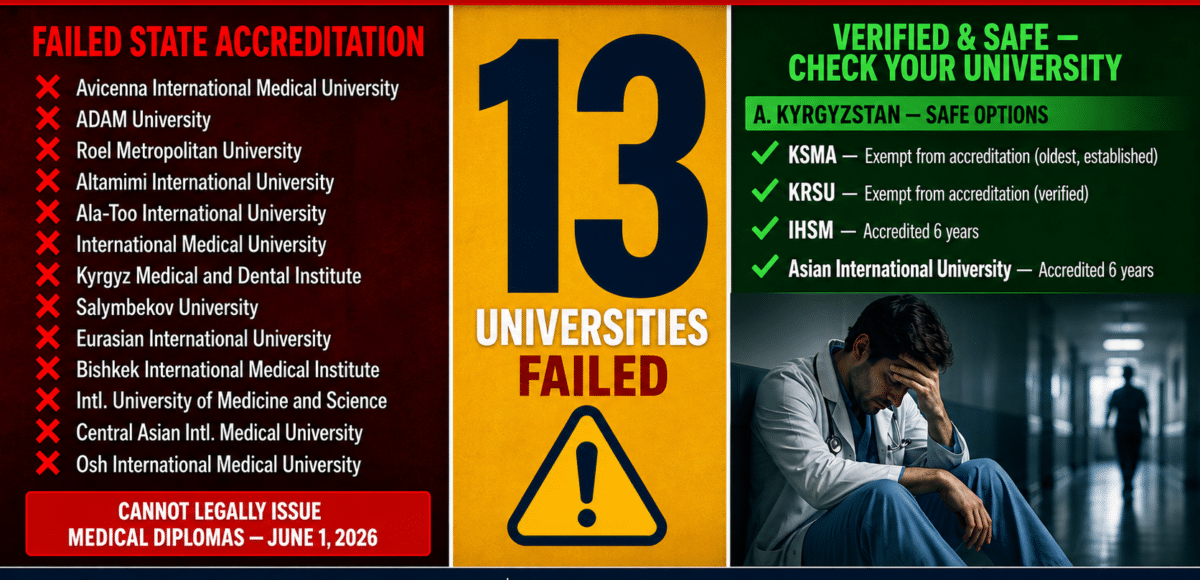
Thirteen medical universities in Kyrgyzstan — institutions that thousands of students, including Indian MBBS aspirants, were enrolled in or actively considering — have failed state accreditation. Effective June 1, 2026, these universities have been deprived of the right to operate and issue diplomas.
Let that settle for a moment.
Not “warned.” Not “placed on probation.” Deprived of the right to issue medical diplomas.
At Neolife Education, we have spent nine years placing over 5,000 students across Russia, Philippines, Uzbekistan, and Kazakhstan. We have seen what happens when students enrol in the wrong university — the shattered dreams, the wasted years, the families who spend everything and receive nothing. Today, we are writing this article with one purpose: to make sure that does not happen to any family who trusts us with their child’s future.
Read every word. Share it with every family you know who is considering MBBS in Kyrgyzstan.
What Exactly Happened — The Official Facts
The Kyrgyz Republic’s Ministry of Health set a clear deadline: all medical universities and colleges in the country had to pass state accreditation by June 1, 2026. The requirement was non-negotiable. Universities that failed to pass accreditation would lose the right to operate and could no longer issue valid medical diplomas.
Kyrgyzstan has 34 universities providing medical training — 12 state-run and 22 private. Three universities — KSMA, KRSU, and KTU “Manas” — were not required to undergo this accreditation process due to their existing legislative status. That left 24 universities that applied for accreditation.
Of those 24, 13 universities failed. That is more than half of all applicants. More than half.
The accreditation assessment evaluated four core criteria: staffing and faculty quality, access to clinical training bases, material and technical infrastructure, and the quality of educational programs. In simpler terms: Do you have qualified teachers? Do your students train in real hospitals? Do you have proper classrooms and labs? Are your programs actually worth the tuition you charge?
Thirteen universities could not answer yes to enough of these questions.
The Full List of Universities That Failed State Accreditation
These are the universities officially confirmed by the Kyrgyz Ministry of Health as having failed state accreditation as of June 1, 2026:
- Avicenna International Medical University
- ADAM University
- Roel Metropolitan University
- Altamimi International University
- Ala-Too International University
- International Medical University
- Kyrgyz Medical and Dental Institute
- Salymbekov University
- Eurasian International University
- Bishkek International Medical Institute
- International University of Medicine and Science
- Central Asian International Medical University
- Osh International Medical University
If your child is currently enrolled at any of these institutions, or if you were planning to apply — this changes everything. These universities cannot legally issue medical diplomas under the new regulatory framework.
We want to be careful here and responsible: this is Kyrgyzstan state accreditation, which is separate from NMC accreditation in India. However, the implications for Indian students are serious and immediate — a university that cannot legally operate in its own country creates profound uncertainty about the future validity of degrees it issues, its operational continuity, and its ability to maintain the standards that NMC compliance requires.
What This Means for Indian Students — The Honest Assessment
Here is the truth that every Indian family considering Kyrgyzstan for MBBS needs to hear — and that most consultants will not tell you directly:
1. Degrees from unaccredited universities create serious legal and professional uncertainty.
A university that has been “deprived of the right to operate and issue diplomas” by its own national government is operating in a legally compromised position. Even if a student completes their course, the validity of a diploma issued by such an institution becomes a legitimate question — in Kyrgyzstan courts, in Indian NMC offices, and potentially in FMGE examination eligibility reviews.
2. NMC compliance is an ongoing requirement, not a one-time stamp.
Many parents believe that once a university is “NMC approved,” that status is permanent. It is not. NMC approval is not a permanent status — it is a compliance framework that universities must continuously satisfy. A university that fails its own country’s accreditation process is, at minimum, raising serious questions about whether it can continue to meet NMC’s requirements around clinical bases, faculty, and infrastructure.
3. This development comes in the context of already-concerning FMGE data.
Over 15,000 Indian students are currently enrolled across Kyrgyz institutions. In FMGE 2024, 15,135 Kyrgyz medical graduates appeared — and only 3,792 passed, a pass rate of 25.05%. Even the best-performing university recorded only 39.66%. For every four Indian students who completed MBBS in Kyrgyzstan and appeared for FMGE, three failed. This is the baseline — and it applies to the accredited universities, not the thirteen that just failed.
4. The universities that failed cited four criteria they could not meet.
The Ministry assessed staffing, clinical bases, material infrastructure, and program quality. These are not administrative checkboxes. These are the exact criteria that determine whether a student receives genuine medical training or a credential without substance. A university that fails these criteria is one where your child may spend six years and emerge without the clinical foundation needed to pass FMGE, practice medicine, or build a career.
Which Universities DID Pass Accreditation — And What That Means
For completeness and fairness, here are the universities that passed state accreditation:
Accredited for 6 years (strongest outcome):
- Osh State University
- International University of Kyrgyzstan
- International Higher School of Medicine (IHSM)
- Asian International University named after S. Tentisheva
Accredited for 1 year (provisional — requires close monitoring):
- Kyrgyz National University named after Zh. Balasagyna
- Jalal-Abad State University
- Kyrgyz-Uzbek International University named after B. Sydykova
- Issyk-Kul State University named after K. Tynystanova
- Jalal-Abad International University
- University of South Asia
- International European University
Not required to undergo accreditation (existing legislative status):
- KSMA (Kyrgyz State Medical Academy) — the oldest and most established
- KRSU (Kyrgyz-Russian Slavic University)
- KTU “Manas”
If a family is committed to Kyrgyzstan, they should consider only the 6-year accredited universities and the three exempted institutions. Universities accredited for only 1 year should be approached with significant caution — they passed, but barely, and must re-demonstrate compliance within 12 months.
The Question Every Indian Parent Must Ask Right Now
If your child is currently enrolled in one of the 13 failed universities — what do you do?
First: do not panic. But do act.
Contact the university and demand written confirmation of their operational status and whether they are pursuing an appeal or agreement with KSMA (as the new regulations require, unaccredited universities may operate only with a formal agreement with KSMA, the national medical academy). Demand clarity on whether diplomas being issued will carry legal validity.
Second: speak to a professional consultant who has direct university relationships and can give you verified, current information — not a freelancing agent who is reading the same headlines you are.
Third: understand your transfer options. Several NMC-approved universities in Russia and the Philippines have established transfer pathways for students from discontinued or compromised institutions. These pathways exist, they are legitimate, and families have used them.
If you have not yet enrolled and were considering any of the 13 failed universities — the decision is simple. Do not enrol until the situation is fully resolved and verified.
Why Choosing the Right Consultant Is Now More Critical Than Ever
What happened in Kyrgyzstan on June 1, 2026 is precisely the scenario that professional MBBS consultants exist to prevent. Not to manage after the fact — but to prevent.
At Neolife Education, every university we recommend has been:
✅ Personally visited by our team — not evaluated from a brochure or a website
✅ Verified for NMC compliance — not just at admission, but on an ongoing basis
✅ Checked for accreditation status in its home country — because a university that cannot satisfy its own government’s standards cannot be trusted with your child’s future
✅ Assessed for clinical training quality — patient inflow numbers, hospital affiliation status, simulation facilities
✅ Confirmed for hostel, mess, and student support infrastructure — because your child’s daily life is as important as their degree
The families who came to us and followed our university recommendations did not end up at Avicenna International Medical University. They did not end up at Ala-Too International University. They ended up at NMC-approved, state-accredited, WHO-listed institutions in Russia, Philippines, Uzbekistan, and Kazakhstan — with proper clinical training, Indian mess facilities, on-ground Neolife support teams, and degrees that are unambiguously valid.
Safe, Verified Alternatives — Countries Where Your Child’s Future Is Protected
If this news has caused you to reconsider Kyrgyzstan entirely — or if you were weighing it against other destinations — here is an honest summary of the alternatives Neolife recommends and verifies:
Russia: Established universities with 40–60 year track records. KSMU, Kazan, Volgograd — all NMC approved, state-funded, government-run. Total cost ₹30–32 Lakhs. The most established MBBS abroad destination for Indian students.
Philippines: Strong English-medium instruction. Outstanding clinical training — high patient inflow hospitals. UV Gullas, AUF, and other top institutions with long records of Indian FMGE success. Total cost ₹35–45 Lakhs. USMLE pathway available.
Uzbekistan: Asia’s fastest-growing verified medical destination. Government universities with strong infrastructure. Total cost ₹25–30 Lakhs. NMC approved. Rapidly improving FMGE outcomes.
Kazakhstan: Established universities in Almaty. Strong Russian medical tradition. NMC approved. Total cost ₹30–38 Lakhs.
In all four countries, Neolife Education holds direct university contracts — meaning your child’s admission goes directly into the university’s official system, your fees go directly to the university, and you have full contractual accountability at every step.
What Neolife Education Is Doing Right Now
We are actively monitoring this situation. Our team is in direct contact with our partner universities across all four countries to confirm that none of our partner institutions are affected by any regulatory changes.
For families currently enrolled at affected Kyrgyzstan universities, we are offering free emergency counselling calls to help assess transfer options, understand the legal implications, and map a path forward.
For families who have not yet enrolled anywhere and are making this decision right now — we are offering our standard free 15-minute counselling call to map your child’s NEET rank, budget, and preferences to the right verified university in the right country.
Drop “URGENT” in the comments below, or WhatsApp us at [your number]. We respond within 2 hours.
Frequently Asked Questions
Q: Does failing Kyrgyzstan state accreditation mean a university automatically loses NMC recognition? A: Not automatically or immediately. NMC accreditation is governed by India’s FMGL Regulations 2021 and evaluated separately. However, a university that has been deprived of operational rights by its own national government creates significant compliance risk for ongoing NMC eligibility. Families should seek immediate clarification and not assume that NMC status is unaffected.
Q: My child is currently enrolled at one of the 13 failed universities. Should they leave immediately? A: Do not make any sudden decisions. Contact the university for written clarity, and contact a professional consultant immediately to understand your transfer options. Acting rashly can create its own set of complications. Acting informed is the priority.
Q: Which Kyrgyzstan universities are now confirmed safe? A: KSMA, KRSU, and KTU “Manas” are not subject to accreditation requirements under the legislation. Among those that applied, Osh State University, IHSM, International University of Kyrgyzstan, and Asian International University were accredited for 6 years — the strongest possible outcome.
Q: Is Russia a better option now given these Kyrgyzstan developments? A: Russia’s NMC-approved universities are government-run institutions with 40–60 year operational histories and established state accreditation frameworks. For Indian families prioritising security and verified quality, Russia, Philippines, and Uzbekistan offer strong, stable alternatives with Neolife’s direct university support.
Q: How do I verify a university’s accreditation before enrolling? A: Check three sources simultaneously: the university’s listing at search.wdoms.org (WHO World Directory of Medical Schools), the NMC website at nmc.org.in, and the official accreditation body of the country in question. If any of the three shows uncertainty — do not enrol until it is resolved.
Final Word — The Responsibility We Feel
Nine years ago, we started Neolife Education because we were angry. Angry at agents who took money from families and disappeared. Angry at universities that promised world-class education and delivered nothing. Angry at a system that left brilliant students without a path.
Today, we are writing this article because that anger has not gone away. It has simply become something more useful: vigilance.
The 13 universities on that list are not just names. They are years of a student’s life. They are a family’s savings. They are a dream that somebody trusted someone else to protect.
We cannot undo what those families are facing today. But we can make sure that the families who come to us never have to face it.
That is the Neolife promise. And it is the only one we will ever make.