MBBS in Russia for Indian Students 2026-27: Complete Guide for Indian Students
If you have qualified NEET and are now looking at your options, Russia deserves your full attention. Every year, over 15,000 Indian students choose to study MBBS in Russia — and the numbers keep growing. The reasons are clear: globally recognised degrees, English-medium teaching, affordable fees, no capitation charges, and NMC-approved universities that prepare graduates well for FMGE and NExT.
But with so many universities, so much conflicting information online, and so many agents giving half-truths, it is hard to know where to start. This guide, prepared by the team at Neolife Education, cuts through the noise. Whether you are a student or a parent researching MBBS in Russia for the first time, this is the most complete, honest, and updated resource you will find for 2026-27.
Quick Answer: MBBS in Russia is a 6-year English-medium programme at NMC-recognised public universities. Annual fees range from RUB 2,88,000 to RUB 5,94,000. NEET qualification is mandatory. Graduates can appear for FMGE/NExT in India.
Why Do Indian Students Choose Russia for MBBS?
Russia has been a destination for Indian medical students for over three decades. It is not a trend — it is a tried and tested pathway that hundreds of thousands of Indian doctors have used to build successful careers. Here is why Russia consistently ranks as one of the top countries for MBBS abroad:
- NMC and WHO Recognition: All top Russian medical universities are recognised by India’s National Medical Commission (NMC) and listed by the World Health Organization (WHO). This means your degree is valid for FMGE/NExT in India.
- English Medium: The full MBBS programme is taught in English. No Russian proficiency required to begin — students learn Medical Russian as a subject in Year 1 to help with clinical placements.
- No Capitation, No Donation: Russian public universities do not charge any capitation or donation fees. What you see in the fee structure is what you pay.
- Genuinely Affordable: Annual tuition fees at top Russian medical universities range from RUB 2,88,000 to RUB 5,94,000 — a fraction of what Indian private medical colleges charge.
- World-Class Clinical Training: Russian universities maintain affiliations with major hospitals where students get real patient exposure from as early as Year 3.
- Safe and Supportive: Russian university cities have well-established Indian student communities, Indian food in hostel messes, 24/7 hostel security, and dedicated international student offices.
Key Fact: Russia produces some of the highest FMGE first-attempt pass rates among all countries where Indian students study MBBS abroad — when students choose the right university and prepare properly.
Eligibility Criteria for MBBS in Russia for Indian Students
Before diving into university options and fees, make sure you meet the basic eligibility requirements. These are set by NMC India and apply to all students seeking MBBS in Russia:
| Criteria | Requirement |
|---|---|
| Minimum Age | 17 years on or before 31st December of the admission year |
| Maximum Age | 25 years (for most universities) |
| Class 12 Subjects | Physics, Chemistry, Biology (PCB) + English as core subjects |
| Minimum PCB Marks | 50% aggregate for General category | 40% for SC/ST/OBC |
| NEET | Mandatory – valid NEET-UG score required (as per NMC norms) |
| Passport | Valid Indian passport with minimum 18 months validity |
| Medical Fitness | Certificate from a registered medical practitioner |
| HIV Certificate | Negative HIV test from a certified lab |
One thing that confuses many students: there is NO separate entrance examination conducted by Russian universities for international admissions. If you have NEET qualification and meet the academic criteria, you are eligible to apply. The process is straightforward once you have the right guidance.
Top NMC-Recognised Medical Universities in Russia for Indian Students 2026-27
Russia has over 40 NMC-recognised medical universities. Not all of them offer the same quality, infrastructure, or student support. Based on clinical infrastructure, FMGE outcomes, Indian student community strength, faculty quality, and transparency of fees, here are the top universities Neolife Education recommends for Indian students in 2026-27:
| University | Location | Est. | Annual Tuition (RUB) | Key Strength |
|---|---|---|---|---|
| Kazan Federal University | Kazan, Tatarstan | 1804 | 5,94,000 | Top QS-ranked | 15,000+ international students |
| Tver State Medical University | Tver (170 km from Moscow) | 1902 | 4,30,000 | Oldest | 10 hospitals | 35+ depts |
| Omsk State Medical University | Omsk, Siberia | 1920 | 3,30,000 | 35 hospitals | 600,000-vol library |
| Kirov State Medical University | Kirov | 1987 | 3,50,000 | NMC aligned | strong FMGE prep |
| Syktyvkar State University | Syktyvkar, Komi | 1972 | 3,00,000 | Most affordable | Indian faculty collab |
| Sevastopol State University | Sevastopol, Crimea | 1951 | 2,88,000 | Black Sea campus | mild climate |
All universities listed above are NMC-recognised and WHO-listed. Each has its own distinct advantages — from location and climate to fee levels and clinical infrastructure. Neolife Education helps you match the right university to your specific needs, budget, and NEET score.
Russia MBBS Fees for Indian Students 2026-27 – What Does It Really Cost?
This is the question every family asks first — and rightly so. Here is a clear, honest answer broken down into every component of the actual cost of studying MBBS in Russia.
Tuition Fees
Annual tuition fees at NMC-recognised Russian medical universities range from RUB 2,88,000 to RUB 5,94,000 per year depending on the university. There are no capitation fees and no annual fee hikes beyond the officially declared rate.
Hostel Fees
Hostel fees are separate from tuition and range from RUB 18,000 to RUB 85,000 per year depending on the university and room type. All hostels are on or near campus with 24-hour security, central heating, Wi-Fi, and Indian food options.
Living Expenses in Russia
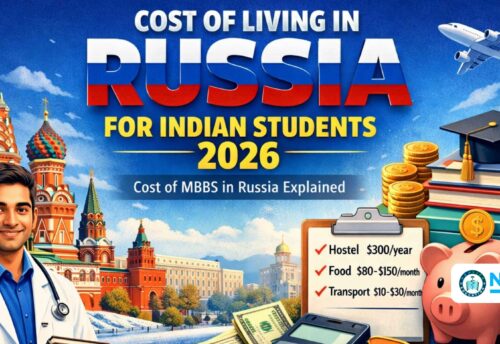
Russia is genuinely affordable for Indian students. Monthly living costs — including food, local transport, personal expenses, and entertainment — typically range from RUB 8,000 to RUB 18,000 per month depending on the city and lifestyle.
Total 6-Year Cost Estimate
| Cost Category | Low-End (RUB) | Mid-Range (RUB) | High-End (RUB) |
|---|---|---|---|
| Tuition (6 years) | 17,28,000 | 21,00,000 | 35,64,000 |
| Hostel (6 years) | 1,08,000 | 3,00,000 | 5,10,000 |
| Living Expenses (6 yrs) | 5,76,000 | 9,00,000 | 12,96,000 |
| Visa + Insurance + Misc | 50,000 | 75,000 | 1,00,000 |
| TOTAL ESTIMATED | ~24,62,000 | ~33,75,000 | ~54,70,000 |
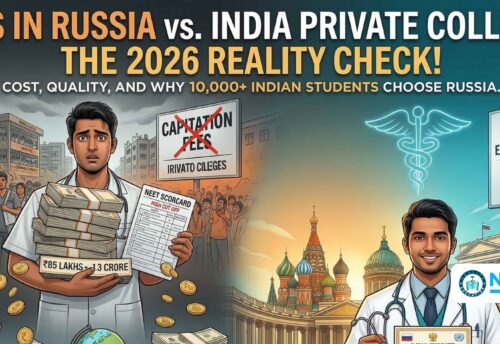
Compare: Indian private medical college fees alone range from Rs. 60 lakh to Rs. 1.5 crore for the complete MBBS — without the international exposure and global recognition of a Russian university degree.
How to Study MBBS in Russia – Step-by-Step Admission Process for 2026-27
The admission process for MBBS in Russia is simpler than most students expect. Here is exactly how it works, step by step:
- Check Eligibility: Confirm you meet the age, PCB marks, and NEET qualification requirements set by NMC.
- Choose Your University: Shortlist 2-3 universities based on fees, location, recognition, and clinical infrastructure. Neolife Education provides free personalised counselling to help you do this.
- Submit Application: Fill the university application form and submit scanned copies of your 12th marksheet, NEET scorecard, and passport. No application fee at most universities.
- Receive Admission Letter: The university reviews your documents (typically 3-5 working days) and issues an official Admission / Confirmation Letter.
- Arrange Invitation Letter: Your representative applies to the university for a formal Invitation Letter — the document needed for your Russian student visa. This takes 10-14 days.
- Pay First-Year Fees: Pay the first-year tuition and hostel fees to secure your seat and confirm your enrolment.
- Apply for Student Visa: Submit your visa application at the Russian Embassy or Consulate in India along with the Invitation Letter, passport, and required documents.
- Travel to Russia: Fly to Russia (typically September intake). Most universities arrange airport reception and transport to the hostel for arriving students.
- Begin Your MBBS: Attend orientation, complete migration registration within 7 days of arrival, and start your first semester.
Application window: Most universities open applications in May and close them in August for September intake. Do not wait until August — popular universities fill seats early and processing takes time.
Documents Required for MBBS Admission in Russia
Prepare these documents well in advance. All originals must be attested; documents in regional languages need certified English translations.
- Class 10 (SSC) mark sheet and passing certificate
- Class 12 (HSC) mark sheet with PCB subjects
- NEET-UG scorecard (current or previous 2 years depending on university policy)
- Valid Indian passport (minimum 18 months validity from travel date)
- 3-4 passport-size photographs
- Medical fitness certificate from a registered doctor
- HIV test result (negative, from a certified lab)
- Birth certificate
MBBS Curriculum in Russia – What Will You Study for 6 Years?
The Russian MBBS (called General Medicine or MD in Russia) follows a structured 6-year programme divided into pre-clinical, para-clinical, and clinical phases. Here is a year-by-year overview:
| Year | Focus | Key Subjects |
|---|---|---|
| Year 1 | Pre-Clinical Foundation | Anatomy, Biochemistry, Histology, Medical Biology, Medical Latin, Medical Russian |
| Year 2 | Biomedical Sciences | Physiology, Microbiology, Pathological Anatomy, Introduction to Clinical Medicine |
| Year 3 | Para-Clinical + Hospital Entry | Pathophysiology, Pharmacology, Propedeutics, Surgery Basics – Hospital placements begin |
| Year 4 | Core Clinical | Internal Medicine, Surgery, Obstetrics, Neurology, ENT, Ophthalmology, Psychiatry |
| Year 5 | Advanced Clinical Rotations | Advanced Internal Medicine, Paediatrics, Oncology, Emergency Medicine, Infectious Diseases |
| Year 6 | Final Clinical + Exams | Polyclinic Medicine, Rehabilitation, Anaesthesiology, State Final Examination (OSCE) |
| Year 7 (Internship) | Mandatory Clinical Internship | 1-year supervised clinical practice in Internal Medicine, Surgery, or Paediatrics |
The curriculum is fully taught in English for international students. Medical Russian is taught as a subject from Year 1 to help with patient communication during hospital rotations. By the time you graduate, you will not only have a medical degree — you will also be functionally conversational in Russian, which is a real-world advantage in clinical settings.
FMGE and NExT: Can You Practise in India After MBBS in Russia?
Yes — absolutely. But there is one important step. All Indian students who earn an MBBS degree abroad must clear the FMGE (Foreign Medical Graduate Examination) — now transitioning to NExT (National Exit Test) — to obtain a licence to practise medicine in India.
The national FMGE pass rate has historically been below 20% across all foreign MBBS graduates. This is not because Russia is a bad destination — it is because many students do not choose the right university, do not engage seriously with their curriculum, or do not prepare for FMGE alongside their studies.
When you study at an NMC-aligned university with a strong English-medium curriculum, real clinical exposure from Year 3, and active FMGE preparation support — your chances improve dramatically. The best Russian medical universities consistently produce graduates with above-average FMGE first-attempt pass rates.
Neolife Education Tip: Start FMGE preparation from Year 1. Do not treat it as a post-graduation exam. Treat it as a parallel qualification you are working towards every year of your MBBS.
What Is Life Like for Indian Students in Russia?
This is the question students do not always think to ask — but it is one of the most important ones. You are going to live in Russia for six years. Your wellbeing, happiness, and performance all depend on the quality of that daily life. Here is an honest picture:
Indian Community
Every major Russian medical university city has a well-established Indian student community. At top universities, the Indian student count ranges from 200 to over 1,000. You will not be alone. Indian student associations organise Diwali, Holi, Independence Day, cricket tournaments, and cooking events throughout the year.
Indian Food
Indian food is available at most university hostel messes — specifically catered for Indian students. Indian grocery items (rice, lentils, spices, cooking oils) are available at local markets and can be ordered online. Most students also cook their own food in hostel kitchen facilities.
Safety
Russia is safe for Indian students. University hostels have 24-hour CCTV security, separate floors for male and female students, and campus police presence. Russian university cities are orderly and student-friendly. The Indian student communities at each university also provide practical safety guidance and peer support to newly arriving students.
Climate
Russian winters are cold — this is the honest reality. Temperatures can fall to -15 to -30 degrees Celsius depending on the city. But all university buildings and hostels are centrally heated with 24-hour hot water. Students adapt within their first winter, invest in appropriate winter clothing, and many come to enjoy the change of seasons. Summer months (June-August) are warm and pleasant.
Language
All MBBS classes are taught in English. Russian is taught as a subject from Year 1. By Year 3, most students are conversationally functional in Russian, which makes hospital placements and daily life significantly more comfortable. Learning even basic Russian is a genuine asset.
Frequently Asked Questions – MBBS in Russia for Indian Students
Is MBBS in Russia valid in India?
Yes. Graduates of NMC-recognised Russian medical universities are fully eligible to appear for FMGE/NExT in India and practise medicine upon qualifying. The NMC recognition is the legal basis for this eligibility.
Is NEET compulsory for MBBS in Russia?
Yes. As per NMC regulations, all Indian students must have a valid NEET-UG qualification to enrol in MBBS at any foreign medical university — including in Russia. There is no exemption from this requirement.
What is the total cost of MBBS in Russia for Indian students?
The total cost of MBBS in Russia for Indian students — including tuition, hostel, and living expenses over 6 years — typically ranges from approximately RUB 25,00,000 to RUB 55,00,000 depending on the university and city. This is significantly lower than Indian private medical college fees.
What is the duration of MBBS in Russia?
The MBBS programme in Russia is 6 years in total — 5 years of academic study plus 1 year of mandatory clinical internship. The degree awarded is MD (General Medicine), which is equivalent to an MBBS degree in India.
Can I get Indian food in Russia?
Yes. Most top Russian medical universities with large Indian student communities provide Indian food in hostel messes. Indian groceries are also available at local markets and can be ordered online from Indian-friendly stores in major Russian cities.
Which is the best city for MBBS in Russia?
Popular cities for Indian students include Kazan, Tver, Omsk, Kirov, Syktyvkar, and Sevastopol. Each has its own advantages — Kazan is multicultural and internationally active; Tver is close to Moscow; Sevastopol has a mild Black Sea climate; Syktyvkar and Omsk offer the lowest costs. The best city depends on your university choice, budget, and lifestyle preference.
Why Choose Neolife Education for Your MBBS in Russia?
At Neolife Education, we do not simply help students get admission to a Russian university. We help students build a medical career — and that means getting every step right, from university selection and documentation to visa processing, pre-departure preparation, and ongoing support throughout your 6-year MBBS journey.
- 100% transparent process — no hidden fees, no misleading promises
- Direct university relationships with all recommended NMC-recognised universities
- Free personalised counselling — we evaluate your NEET score, budget, and preferences before recommending any university
- Complete documentation, visa, and travel support
- Post-arrival support network in Russia — our team is present on the ground
- FMGE preparation guidance built into our student support from Year 1
Take the next step. Contact Neolife Education today for a free, no-obligation counselling session. We will help you understand exactly which Russian university suits your profile — and how to get there with complete confidence.