
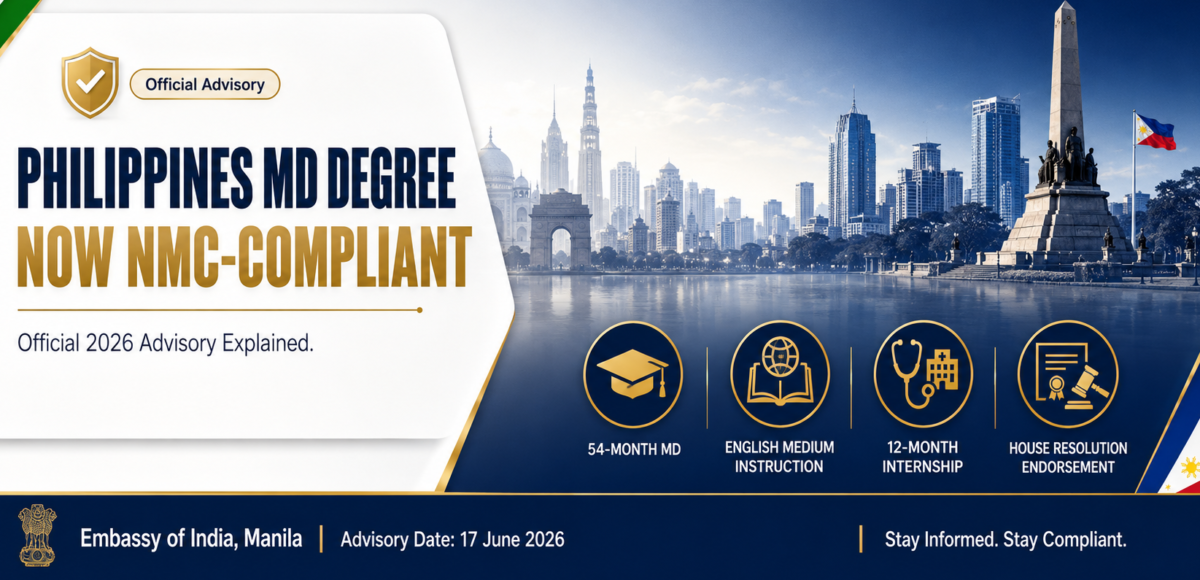
Philippines MD Degree Now NMC-Compliant: What the Official 2026 Embassy Advisory Means for Indian MBBS Aspirants
If you’re an Indian student exploring MBBS in Philippines as an option for 2026, there’s a significant official update you need to know about. On 17 June 2026, the Embassy of India, Manila, issued a formal advisory confirming that the Doctor of Medicine (MD) degree awarded by CHED-recognized institutions in the Philippines complies with the curriculum requirements prescribed under India’s Foreign Medical Graduate Licentiate (FMGL) Regulations. This is one of the clearest and most consequential updates for Indian students considering the Philippines as their MBBS destination in recent years, and in this article, we’ll break down exactly what it means, what it doesn’t mean, and what you should still verify before taking admission.
This isn’t a marketing claim or a third-party interpretation — it is sourced directly from the official advisory published by the Embassy of India in Manila, dated 17 June 2026, referencing communication from the Commission on Higher Education (CHED) of the Philippines and a resolution passed by the Philippine House of Representatives.
What Exactly Did the Embassy of India Confirm?
According to the official advisory, the Commission on Higher Education (CHED), through a letter dated 8 May 2025, informed the Embassy that the MD degree awarded by Higher Education Institutions (HEIs) in the Philippines complies with the requirements prescribed under the FMGL Regulations. Specifically, the advisory confirms four structural elements of the Philippine MD programme:
- A 54-month Doctor of Medicine programme (this duration excludes the pre-medical BS programme that some Philippine universities require before the MD itself begins) offered at various CHED-recognized institutions.
- Mandatory subjects that align with Schedule-I of the National Medical Commission of India’s notification dated 18 November 2021 — this is the specific NMC document that lays out the subject and curriculum requirements foreign medical graduates must meet.
- 100% English-medium instruction throughout the programme.
- A 12-month mandatory internship, completed either at the same medical institution or its officially attached hospital.
In simple terms, this advisory confirms that the academic structure of the Philippine MD programme — its duration, subject coverage, language of instruction, and internship requirement — matches what India’s NMC requires of foreign medical degrees under the 2021 regulations. For thousands of Indian families evaluating MBBS options abroad, this directly addresses one of the most persistent doubts about studying medicine in the Philippines: whether the degree structure itself would even be considered valid back home.
The Role of Philippine House Resolution No. 73
The advisory also references Resolution No. 73, adopted by the House of Representatives of the Philippines on 11 March 2026. This resolution formally endorses the position that the MD programme earned at CHED-recognized institutions is fully compliant with NMC regulations specifically for Indian students studying medicine abroad.
The resolution goes further, stating that the full practice of medicine is a privilege granted to all MD programme graduates — whether Filipino citizens or foreign nationals — once they pass the Physician Licensure Examination (PLE), and, in the case of foreign nationals, subject to compliance with Philippine immigration laws.
This is an important governmental-level endorsement. It signals that the Philippine legislature itself has taken a formal position recognizing the seriousness with which Indian students’ regulatory concerns are being addressed, and it reflects ongoing coordination between Philippine education authorities and the Indian Embassy on this issue.
An Important Caveat: The PLE Reciprocity Question
While the curriculum compliance update is genuinely positive news, the advisory also includes an important and easily overlooked caveat that every prospective student should understand clearly.
As per existing Philippine law, all medical graduates — Filipino or foreign — are required to pass the Physician Licensure Examination (PLE) if they wish to register and practice medicine within the Philippines. However, the advisory specifies that foreign medical graduates can only sit for the PLE if the laws of their home country permit Filipino citizens to practice medicine under the same rules that govern that country’s own citizens — a principle known as reciprocity.
The advisory explicitly states: “Guidance from the competent authorities in India on establishing the reciprocity required under Philippine laws is awaited.”
This means that, as of the date of this advisory, the reciprocity arrangement between India and the Philippines for PLE purposes has not yet been finalized. This specific point matters primarily for students who intend to practice medicine within the Philippines after graduation — it does not affect the core pathway that the vast majority of Indian MBBS-abroad students actually follow, which is returning to India and appearing for the Foreign Medical Graduate Examination (FMGE) or its successor, the National Exit Test (NExT), to obtain a license to practice in India.
It’s worth noting, too, that according to CHED, there is no PLE requirement at all for medical graduates who intend to practice in the USA, UK, Canada, Australia, Switzerland, and similar countries — for those students, a different set of country-specific licensing examinations (such as the USMLE for the US) applies after they fulfill the requirements set by those respective countries.
Why This Distinction Matters for Indian Students
If you’re an Indian student planning to study MD in the Philippines with the intention of returning to India to practice, this advisory is directly relevant and largely reassuring: the academic structure of your degree now has documented, official confirmation that it aligns with NMC’s prescribed criteria. This addresses curriculum-level compliance, which is foundational to your eventual FMGE/NExT eligibility.
If, however, your goal is to remain in the Philippines and build a medical career there, the PLE reciprocity question is one you should track closely, since it remains unresolved as of this advisory. We’d recommend checking directly with the Embassy of India in Manila or your chosen university’s international admissions office for the latest status before making plans contingent on practicing in the Philippines specifically.
The Embassy’s Direct Recommendation to Students
Perhaps the most operationally important line in the entire advisory is point 6, where the Embassy states plainly:
“Prospective students who intend to take admission in CHED-recognized medical institutions in the Philippines and intend to return and practice in India should verify and satisfy themselves that all NMC-prescribed conditions and criteria are met.”
This is the Embassy’s own guidance, and it’s worth taking seriously. While the curriculum-level compliance confirmation is a meaningful and positive development, due diligence remains the responsibility of the individual student and family. Before finalizing admission anywhere in the Philippines, here is what we’d recommend verifying:
- Confirm CHED recognition status of the specific institution and specific MD programme you’re considering — not all institutions or programmes may carry identical recognition status.
- Verify the programme duration is the full 54 months (excluding any separate pre-medical BS phase), matching what the advisory describes.
- Check that the curriculum includes all subjects specified under Schedule-I of the NMC’s 18 November 2021 notification.
- Confirm the internship arrangement — ensure the 12-month internship will be conducted at the medical institution itself or at a hospital formally and officially attached to it.
- Stay updated on FMGE/NExT requirements, since NMC regulations and examination formats can be revised, and what applies at the time of your admission should be reconfirmed periodically through your study period.
- Maintain all your academic documentation meticulously — admission letters, curriculum structure documents, internship certificates, and the institution’s CHED recognition certificate — as these will likely be required at the time of your FMGE/NExT application in India.
Why the Philippines Continues to Be a Strong Choice for Indian MBBS Aspirants
Beyond this specific regulatory update, the Philippines has built a long-standing reputation among Indian families as a genuinely comfortable and academically credible destination for MBBS education, and this advisory reinforces several of the reasons why:
English-medium instruction throughout. As confirmed directly in this advisory, the MD programme is conducted entirely in English. Indian students transitioning from English-medium schooling in India typically face no language adjustment at all — lectures, textbooks, clinical rotations, and examinations are all conducted in English from day one.
Academic structure built for FMGE alignment. With Schedule-I subject compliance now formally acknowledged, students can have greater confidence that their coursework is genuinely structured to prepare them for India’s licensing examination, rather than requiring extensive independent bridging study after graduation.
Cultural and climatic familiarity. The Philippines’ tropical climate closely mirrors conditions across much of India, and its culture — shaped by centuries of diverse influences — tends to feel notably less foreign to Indian students than some other overseas MBBS destinations.
Established Indian student communities. Most major Philippine medical universities host substantial communities of Indian students, along with access to Indian food, informal peer support networks, and, in many cases, dedicated facilities catering to Indian dietary needs.
Clinical exposure through affiliated hospitals. Many CHED-recognized medical institutions maintain strong relationships with teaching hospitals, giving students structured, hands-on clinical exposure well before their internship year begins.
What Should You Do Next?
If you’re currently evaluating MBBS options abroad and the Philippines is on your shortlist, this advisory should genuinely raise your confidence in the Philippines as a credible, NMC-aligned destination — provided you do the groundwork the Embassy itself recommends. Specifically:
- Shortlist only CHED-recognized institutions with a clearly documented 54-month MD programme structure.
- Request curriculum documentation from your shortlisted university that maps directly to Schedule-I of the NMC’s November 2021 notification.
- Ask direct questions about internship arrangements — confirm in writing where and how the 12-month internship will be conducted.
- Consult with a qualified overseas education advisor who stays current with NMC and Embassy advisories, since regulatory positions can be refined or updated over time.
- Keep a personal file of all official documentation, including this advisory itself, your admission letter, curriculum breakdown, and your institution’s CHED recognition proof.
Final Thoughts
The 17 June 2026 advisory from the Embassy of India, Manila, represents a genuinely significant and welcome clarification for thousands of Indian families considering MBBS in the Philippines. It directly confirms — through official channels, based on CHED’s own communication and a formal Philippine House Resolution — that the structural and curricular elements of the Philippine MD programme align with what India’s National Medical Commission requires under its 2021 regulations.
At the same time, responsible reporting means being transparent about what remains unresolved: the PLE reciprocity arrangement for those wishing to practice within the Philippines is still pending guidance from Indian authorities, and the Embassy itself continues to place the responsibility on individual students to verify that all NMC-prescribed conditions are satisfied before and during their studies.
For students whose plan is to study in the Philippines and return to India to practice — which describes the overwhelming majority of Indian MBBS-abroad aspirants — this advisory is unambiguous good news about the credibility and compliance of the Philippine MD pathway. As always, pair this official information with personalized guidance from your university and education consultant to make sure your specific programme and circumstances are fully aligned with current NMC requirements.
This article is based on the official advisory “Advisory on Medical Education in the Philippines,” published by the Embassy of India, Manila, on 17 June 2026. For the most current and authoritative information, please refer directly to the Embassy of India, Manila’s official website and consult your chosen university’s CHED recognition documentation.

Leave a Comment