
PG Medical in Australia After MBBS: The Complete 2025 Guide for Indian Students
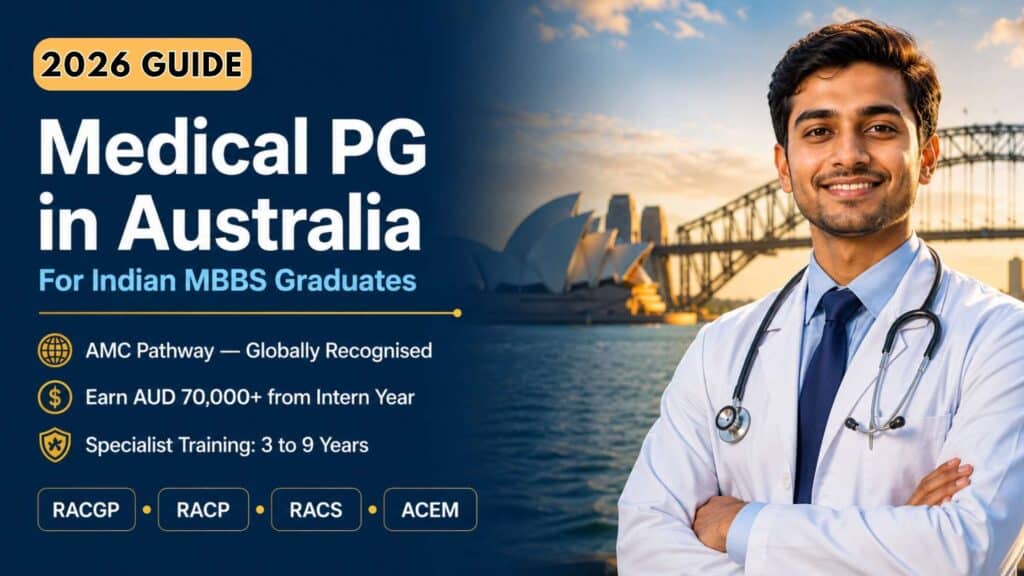
Every year, thousands of Indian MBBS graduates look beyond borders for a postgraduate medical career that offers world-class training, handsome salaries, and a high quality of life. PG medical in Australia has emerged as one of the most sought-after pathways — and for good reason. Australia’s healthcare system consistently ranks among the best globally, its hospitals are well-funded, and doctors earn among the highest salaries in the world.
If you are an Indian MBBS graduate wondering how to pursue post graduation after MBBS in Australia, this comprehensive guide covers every step — from the Australian Medical Council (AMC) exams and registration to specialist training programs, visa pathways, costs, and career prospects. We have also included a comparison with PG in Germany so you can make the most informed decision for your medical career.
| Quick Fact: Australia has approximately 106,000 registered medical practitioners. The demand for specialists and general practitioners continues to grow, with nearly 9,000 new doctors needed by 2030 — creating enormous opportunities for qualified Indian MBBS graduates. |
Why Choose PG Medical in Australia After MBBS?
Before diving into the process, it is worth understanding why so many Indian doctors choose post graduation after MBBS in Australia over other destinations like the US, UK, or even PG in Germany.
1. World-Class Healthcare Training
Australia’s postgraduate medical training is delivered through royal colleges — bodies like the Royal Australian College of General Practitioners (RACGP), the Royal Australasian College of Physicians (RACP), and the Royal Australasian College of Surgeons (RACS). These institutions set gold-standard training curricula that are recognised worldwide.
2. Completely English-Medium Training
Unlike PG in Germany, where Indian doctors must achieve B2–C1 German language proficiency before sitting licensing exams, all medical practice and training in Australia takes place in English. For Indian MBBS graduates from English-medium universities, this significantly lowers the language barrier.
3. Among the Highest Doctor Salaries Globally
| Level | Annual Salary (AUD) | INR Equivalent (Approx.) |
| Intern / PGY1 | AUD 70,000–80,000 | ~INR 38–44 Lakh |
| Resident / PGY2–3 | AUD 85,000–100,000 | ~INR 47–55 Lakh |
| Registrar (Specialist Trainee) | AUD 100,000–130,000 | ~INR 55–72 Lakh |
| Consultant / Specialist | AUD 200,000–500,000+ | ~INR 1.1–2.7 Crore |
| General Practitioner (GP) | AUD 150,000–300,000 | ~INR 83 Lakh–1.6 Crore |
4. Permanent Residency Pathway for Medical Professionals
Australia actively incentivises doctors to work in regional and rural areas, offering fast-tracked Permanent Residency (PR) through the Regional Sponsored Migration Scheme and employer-sponsored visas. For Indian MBBS graduates, this creates a clear pathway to permanent settlement.
5. Excellent Work-Life Balance
Australian hospitals operate under structured working-hour regulations. Unlike many other countries where residents work 80-hour weeks routinely, Australia enforces safe working hours, ensuring postgraduate trainees maintain a healthy balance between professional growth and personal life.
Eligibility Criteria for PG in Australia After MBBS
To begin your journey toward PG medical in Australia, you must fulfil the following eligibility requirements:
| Degree | MBBS (Bachelor of Medicine, Bachelor of Surgery) from a recognised medical university listed in the World Directory of Medical Schools (WDOMS) |
| Recognition | Your MBBS institution must be recognised by the Australian Medical Council (AMC) |
| Language Proficiency | IELTS Academic: Overall 7.0 (no band below 7.0) OR OET: Grade B in all four sub-tests |
| AMC MCQ Exam | Pass the AMC Computer Adaptive Test (CAT MCQ Examination) |
| AMC Clinical Exam | Pass the AMC Clinical Examination (OSCE format — 16 stations) |
| Internship | Completion of at least a 12-month internship (compulsory rotating internship in India satisfies this in most states) |
| Criminal Record Check | Clean police clearance certificate from India and any other country of residence |
| Visa | Valid Australian visa (TSS 482, Training 407, or ENS 186 depending on stage) |
| Important Note: Indian MBBS from universities NOT listed in the WDOMS or those not specifically recognised by AMC will need to undergo additional skills assessment or documentation steps. Always verify your university’s recognition status on the AMC official website before applying. |
Step-by-Step Process: How to Do PG Medical in Australia After MBBS from India
The route to post graduation after MBBS in Australia is a structured, multi-step pathway administered by the Australian Medical Council (AMC). Here is a clear, stage-by-stage breakdown:
Step 1: Check AMC Recognition of Your MBBS Degree
The first step is to verify whether your medical school and MBBS degree is listed in the World Directory of Medical Schools and recognised by the AMC. Graduates from MCI/NMC-approved Indian universities generally qualify. Visit the AMC website and use the ‘Check my qualification’ tool to confirm eligibility.
Image Placeholder 1:
| Alt Tag for Image 1: Step-by-step AMC pathway infographic for Indian MBBS graduates pursuing PG medical in Australia — showing exam stages, registration, internship, and specialist training |
Step 2: Prepare for & Clear the AMC CAT MCQ Examination
The AMC Computer Adaptive Test (CAT) is a 150-question multiple-choice examination that assesses your medical knowledge across all major clinical disciplines. It is conducted at Prometric test centres globally, including in India.
| Exam Format | 150 MCQs — Computer Adaptive |
| Duration | 3.5 hours |
| Passing Score | Minimum passing mark set each year (typically around 65–70%) |
| Test Centres in India | Chennai, Mumbai, Delhi, Hyderabad, Bengaluru, Kolkata |
| Exam Fee | AUD 1,350 (approx. INR 74,000) |
| Validity of Pass | No time limit to attempt Clinical Exam, but must complete within 10 years |
| Number of Attempts | Unlimited (best practice: attempt after 6–12 months of dedicated preparation) |
Pro Tip: Most Indian MBBS graduates who prepare for 8–12 months using AMC-specific question banks (AMC MCQ Practice Apps, AMC Recall Questions, AMC Books) successfully clear the CAT in their first or second attempt. Focus on Internal Medicine, Surgery, Obstetrics & Gynaecology, Paediatrics, and Psychiatry.
Step 3: Clear the AMC Clinical Examination
After passing the MCQ, you must sit the AMC Clinical Examination — an OSCE (Objective Structured Clinical Examination) consisting of 16 rotating stations held in Melbourne, Sydney, or Adelaide.
| Exam Format | 16 OSCE Stations (10 minutes each) |
| Skills Tested | History-taking, Physical Examination, Communication, Procedural Skills, Ethics & Patient Safety |
| Location | Melbourne, Sydney, Adelaide |
| Exam Fee | AUD 2,600 (approx. INR 1.43 Lakh) |
| Attempts | Maximum 4 attempts total |
| Tip | Take a clinical coaching course in Australia before your attempt — hands-on simulation makes a significant difference |
Image Placeholder 2:
| Alt Tag for Image 2: Indian doctor practising OSCE clinical skills at an Australian AMC exam preparation centre for post graduation after MBBS in Australia |
Step 4: Apply for Provisional Registration with a State Medical Board
Once you pass both AMC exams, you apply to the Medical Board of Australia (MBA) via AHPRA (Australian Health Practitioner Regulation Agency) for Provisional General Registration. This allows you to work as an intern in an accredited Australian hospital.
- Create an AHPRA online account and submit your application
- Provide certified copies of your MBBS degree, AMC exam results, identity documents, and police clearance
- Provide evidence of English language proficiency (IELTS/OET scores)
- Pay the registration fee (approx. AUD 700)
- Receive Provisional Registration — valid for 12 months, renewable
Step 5: Complete Your Intern Year in an Australian Hospital
All internationally qualified doctors must complete an internship year (also called PGY1 — Postgraduate Year 1) in an accredited Australian hospital. During this year, you rotate through core clinical departments and are paid a full salary.
| Duration | 12 months (full-time, hospital-based) |
| Rotations | General Medicine, General Surgery, Emergency Medicine, and at least one other approved term |
| Salary | AUD 70,000–80,000 per year + benefits |
| Outcome | Upon completion, you upgrade to General Registration with AHPRA |
| Common States | Queensland, Victoria, New South Wales, Western Australia |
Image Placeholder 3:
| Alt Tag for Image 3: Indian MBBS graduate completing internship at an Australian public hospital as part of PG medical in Australia through AHPRA registration pathway |
Step 6: Enter Postgraduate Specialist Training Program
After obtaining General Registration and completing your intern year, you can apply for specialist vocational training through one of Australia’s royal medical colleges. This is the core of your PG medical in Australia — equivalent to doing MD/MS in India but within a structured employment-based training system.
Top Postgraduate Medical Specialties Available in Australia for Indian Doctors
| Specialty | Training Body | Training Duration |
| General Practice (GP) | RACGP / ACRRM | 3 Years |
| Internal Medicine | RACP | 6–9 Years |
| Surgery (General) | RACS | 5–7 Years |
| Emergency Medicine | ACEM | 5–6 Years |
| Psychiatry | RANZCP | 5 Years |
| Obstetrics & Gynaecology | RANZCOG | 6 Years |
| Anaesthesia | ANZCA | 5 Years |
| Radiology | RANZCR | 5 Years |
| Paediatrics | RACP (Paeds) | 4–6 Years |
| Orthopaedic Surgery | RACS (Ortho) | 6–8 Years |
Most Popular Choice for Indian Doctors: General Practice (GP) through RACGP is the most accessible pathway — shorter training duration, strong demand, excellent salary, and a clear PR pathway especially in rural Australia. However, competitive specialties like Surgery, Internal Medicine, and Psychiatry are equally rewarding for those with specific career goals.
The Complete AMC Pathway — PG in Australia After MBBS at a Glance
Image Placeholder 4:
| Alt Tag for Image 4: Complete AMC pathway flowchart for Indian MBBS students: PG in Australia after MBBS — from AMC CAT MCQ exam to specialist registration and PR |
| Stage | What Happens | Approx. Time |
| Stage 1 | AMC CAT MCQ Examination + Preparation | 6–12 months |
| Stage 2 | AMC Clinical Examination (OSCE) | 3–6 months after MCQ |
| Stage 3 | AHPRA Provisional Registration Application | 2–4 months |
| Stage 4 | Visa Application (TSS 482 / Training 407) | 1–3 months |
| Stage 5 | Intern Year (PGY1) in Accredited Hospital | 12 months |
| Stage 6 | AHPRA General Registration | 1 month |
| Stage 7 | Specialist College Training Program | 3–9 years |
| Stage 8 | Fellowship & Specialist Registration | Upon completion |
| Stage 9 | Apply for Permanent Residency (optional) | After 2+ years of employment |
Cost of PG Medical in Australia for Indian Students
One of the most common questions from Indian MBBS graduates is: ‘How much does PG in Australia after MBBS cost?’ The answer is more encouraging than most expect. Unlike a university master’s degree, the AMC pathway is an examination-based licensure process followed by a salaried training system.
| AMC CAT MCQ Exam Fee | AUD 1,350 (~INR 74,000) |
| AMC Clinical Exam Fee | AUD 2,600 (~INR 1.43 Lakh) |
| AHPRA Registration Fee | AUD 700 (~INR 38,500) |
| English Proficiency Test (IELTS/OET) | INR 15,000–17,000 |
| AMC Preparation Courses (Online/Offline) | INR 30,000–2,50,000 depending on provider |
| Clinical Skills Course in Australia (Optional) | AUD 2,000–5,000 |
| Visa Application Fee (TSS 482) | AUD 2,770 (~INR 1.5 Lakh) |
| Total Estimated Pre-arrival Investment | AUD 8,000–12,000 (~INR 4.4–6.6 Lakh) |
| Salary During Internship (PGY1) | AUD 70,000–80,000/year (INCOME — not a cost) |
| Salary During Specialist Training | AUD 100,000–130,000/year (INCOME — not a cost) |
| Key Takeaway: Unlike MBBS or a traditional Master’s degree abroad, PG medical in Australia does not require you to pay university tuition fees. Once you enter the hospital training system, you are a paid employee. The entire postgraduate training program — from Intern to Fellow — is salary-based, making Australia one of the most cost-effective and financially rewarding PG medical destinations in the world. |
Visa Options for PG After MBBS in Australia
Subclass 482 — Temporary Skill Shortage (TSS) Visa
This is the most common visa for Indian doctors entering the Australian medical system. It is sponsored by a hospital or health service employer and allows you to work in Australia for 2–4 years, with the possibility of extension or transition to PR.
- Employer must be an approved TSS sponsor
- Your occupation (Medical Practitioner / Specialist) must be on the MLTSSL or STSOL
- Minimum salary requirement must be met
- English proficiency: IELTS 5.0 minimum (but AMC requires 7.0 — so you will already qualify)
Subclass 407 — Training Visa
The Training Visa is specifically designed for structured workplace-based training programs. Many state health departments use this visa to bring international medical graduates into their training programs, particularly for specialist training positions.
Subclass 186 — Employer Nomination Scheme (ENS) — Permanent
After working in Australia for at least 3 years on a TSS 482 visa, many Indian doctors transition directly to the ENS 186 visa — a permanent residency visa. This is the most common PR pathway for medical professionals in Australia.
Image Placeholder 5:
| Alt Tag for Image 5: Australian visa options for Indian MBBS graduates pursuing post graduation in Australia — TSS 482, Training 407, and ENS 186 permanent residency pathway |
PG Medical in Australia vs PG in Germany: Which is Better for Indian Doctors?
Many Indian MBBS graduates compare two top international PG destinations: post graduation after MBBS in Australia and PG medical in Germany. Here is an honest, side-by-side comparison:
| Factor | PG Medical in Australia | PG in Germany |
| Language | English (no additional language barrier) | German B2–C1 required (2–3 years) |
| Licensing Process | AMC CAT MCQ + Clinical Exam | FSP (Fachsprachprüfung) + Approbation |
| Training Type | Employment-based (paid training) | Hospital employment (paid) + some university |
| Entry Salary | AUD 70,000–80,000 (Intern) | EUR 55,000–70,000 (Assistenzarzt) |
| Senior Salary | AUD 200,000–500,000+ | EUR 100,000–200,000+ |
| PR Pathway | Straightforward — 2–3 years | EU Blue Card — 21–33 months |
| Specialty Choice | Very broad — all specialties | Broad but harder for non-EU citizens to enter competitive specialties |
| Quality of Life | Exceptional — sunny climate, diverse culture | High — excellent infrastructure, work-life balance |
| Acceptance of Indian Degrees | Established — AMC pathway is well-defined | Varies by state (Bundesland) |
| Best For | English-medium MBBS graduates wanting fast entry to clinical work | Doctors willing to invest 2–3 years in language training for EU residency |
Verdict: For most Indian MBBS graduates, PG medical in Australia offers a faster, more accessible, and equally lucrative pathway compared to PG in Germany. However, if you are passionate about Europe and willing to invest in German language training, PG in Germany remains an outstanding choice for long-term European settlement.
Top Medical Universities and Training Hospitals in Australia for Indian Doctors
While PG medical in Australia is not strictly about ‘universities’ (it is a college-based training system), the following institutions are central to postgraduate medical education:
Leading Teaching Hospitals for PG Training
| Royal Melbourne Hospital (VIC) | General Medicine, Emergency, Surgery, Neurology training hub |
| Royal Prince Alfred Hospital (NSW) | Leading teaching hospital — Cardiology, Renal, Transplant |
| Princess Alexandra Hospital (QLD) | Quaternary care centre — Surgery, Internal Medicine, Oncology |
| Royal Adelaide Hospital (SA) | Major trauma and surgical training centre |
| Sir Charles Gairdner Hospital (WA) | Neurosciences, Oncology, General Medicine |
| Monash Medical Centre (VIC) | Paediatrics, O&G, Internal Medicine |
| John Hunter Hospital (NSW) | Rural and regional medicine training — excellent for PR |
| Gold Coast University Hospital (QLD) | Newer facility with excellent teaching programs |
Medical Colleges Offering Postgraduate Training Programs
- Royal Australian College of General Practitioners (RACGP) — General Practice
- Royal Australasian College of Physicians (RACP) — Internal Medicine & Paediatrics
- Royal Australasian College of Surgeons (RACS) — All surgical specialties
- Australian College for Emergency Medicine (ACEM) — Emergency Medicine
- Royal Australian and New Zealand College of Psychiatrists (RANZCP) — Psychiatry
- Royal Australian and New Zealand College of Obstetricians and Gynaecologists (RANZCOG)
- Australian and New Zealand College of Anaesthetists (ANZCA)
- Royal Australian and New Zealand College of Radiologists (RANZCR)
Image Placeholder 6:
| Alt Tag for Image 6: Map of top teaching hospitals in Australia for Indian MBBS graduates pursuing PG medical training — Melbourne, Sydney, Brisbane, Adelaide, Perth |
Practical Tips to Crack the AMC Exams and Succeed in PG After MBBS in Australia
For the AMC CAT MCQ Exam:
- Use AMC-specific resources: AMC MCQ Preparation App, AMC past papers, AMConline question bank
- Focus on clinical scenarios: All MCQs are case-based — never pure theory
- Allocate 6–12 months: Part-time preparation while working or 3–4 months if studying full-time
- Take mock tests weekly: Simulation of 150-question timed tests is crucial
- Key subjects: Medicine (40%), Surgery (20%), O&G (15%), Paediatrics (10%), Psychiatry (10%), Other (5%)
For the AMC Clinical Examination:
- Join a clinical coaching course: Based in Melbourne or Sydney, these 2–4 week intensive programs are game-changers
- Practice with peers: Role-play OSCE scenarios repeatedly
- Australian communication style: Understand the Australian approach to patient communication — empathetic, structured, clear
- Know the RACGP Red Book: Many clinical station scenarios are based on Australian general practice guidelines
- Book your exam early: Clinical exam slots are limited — apply as soon as you pass the MCQ
General Career Advice for PG in Australia After MBBS:
- Connect with the International Medical Graduate (IMG) community in Australia — Facebook groups, Reddit forums
- Apply to multiple states simultaneously for your intern year — Victoria, Queensland, and NSW have the most positions
- Consider rural areas for internship — they offer better acceptance rates, incentive payments, and faster PR
- Get your documents certified and notarised well in advance — AHPRA processing can take 3–4 months
- Build a strong LinkedIn profile highlighting your Indian clinical experience — Australian hospital HR teams do look at these
Image Placeholder 7:
| Alt Tag for Image 7: Indian doctor studying AMC MCQ preparation materials for post graduation after MBBS in Australia — exam books, laptop, question bank on screen |
Career Scope After PG Medical in Australia for Indian Doctors
Completing post graduation after MBBS in Australia opens extraordinary career doors. Here is what your life can look like as a qualified specialist or GP in Australia:
Job Market Demand
Australia consistently faces a shortage of doctors, particularly in rural and regional areas. The Australian Institute of Health and Welfare (AIHW) projects a shortage of over 9,000 doctors by 2030. This means qualified Indian doctors who complete PG medical in Australia will enter a highly favourable job market.
Work Options After Completing PG Medical in Australia
- Public Hospital Consultant — Stable salary, superannuation, generous leave
- Private Practice — Higher earning potential (AUD 300,000–700,000+)
- Academic / Research Positions — University-affiliated teaching hospital roles
- Rural GP — Incentivised payments, streamlined PR, excellent lifestyle
- Fly-In-Fly-Out (FIFO) Doctor — Remote community medicine, excellent pay
- International Consultant — Your Australian fellowship is recognised globally
Permanent Residency After PG in Australia
After 2–3 years of employment in Australia, most Indian doctors qualify for Permanent Residency through employer-sponsored visas (ENS 186) or independent skilled visas (Subclass 189/190). Doctors who work in rural or regional areas can access PR even faster through the Regional Sponsored Migration Scheme (RSMS) or the Subclass 494 visa.
Image Placeholder 8:
| Alt Tag for Image 8: Indian specialist doctor working at an Australian public hospital after completing PG medical in Australia — career scope and permanent residency pathway |
Frequently Asked Questions: PG Medical in Australia After MBBS
Can I do PG in Australia after MBBS from India?
Yes, absolutely. Indian MBBS graduates whose degrees are from NMC (formerly MCI)-recognised medical universities listed in the WDOMS can apply for the AMC pathway and pursue post graduation after MBBS in Australia. Thousands of Indian doctors have successfully followed this route.
How long does it take to complete PG medical in Australia?
The total timeline from starting AMC preparation to completing specialist training is approximately 9–14 years, depending on your specialty. General Practice (GP) training takes the shortest route — approximately 5–6 years from when you begin AMC preparation to becoming a FRACGP-qualified doctor.
Is PG in Australia after MBBS worth it for Indian students?
For most Indian MBBS graduates, PG medical in Australia is absolutely worth it. The combination of world-class training, high salaries (among the highest for doctors globally), English-medium practice, excellent lifestyle, and a straightforward PR pathway makes Australia one of the best choices for post-MBBS medical careers internationally.
What is the difference between AMC pathway and direct university PG programs in Australia?
The AMC pathway (also called the vocational training pathway) is the standard route for international medical graduates to become registered and practise medicine in Australia. University-based PG programs (like a Master of Medicine or Master of Public Health) do exist but do not lead to clinical specialist registration on their own — they are supplementary qualifications. To practise as a clinician, the AMC pathway is mandatory.
Can I bring my family to Australia while doing PG after MBBS?
Yes. Most Australian work visas (TSS 482, ENS 186, Training 407) allow secondary applicants — your spouse and dependent children can accompany you. Your spouse may also receive open work rights on a TSS 482 visa, enabling them to work in any occupation in Australia.
Is PG medical in Australia better than PG in Germany for Indian doctors?
Both have strong merits. Australia requires no additional language learning (entire system is in English), has a very structured AMC pathway, and offers higher average salaries for doctors. PG in Germany requires German language proficiency (typically 2–3 years of learning) but offers the advantage of European Union residency. For Indian MBBS graduates who want to begin clinical training quickly, PG medical in Australia is generally the faster and more accessible route.
Conclusion: Start Your Journey to PG Medical in Australia Today
Post graduation after MBBS in Australia is not just a dream — it is an achievable, well-defined career pathway for motivated Indian medical graduates. From the AMC examination process to hospital training, specialist registration, and permanent residency, every step is clear, structured, and has been successfully navigated by thousands of Indian doctors before you.
Whether you are comparing PG in Australia after MBBS versus PG in Germany, or deciding between different specialties, the most important step is to start early, prepare rigorously for your AMC exams, and connect with the IMG community in Australia for peer guidance.
Ready to begin? Book a free consultation with our expert counsellors who specialise in helping Indian MBBS graduates plan their medical careers in Australia. We will guide you through AMC preparation, visa applications, hospital applications, and every step of your PG journey in Australia.