
ALERT for Indian MBBS Aspirants: The “6-Year” Vietnam MBBS Course Could Actually Take Much Longer — Here’s What the Embassy Just Warned
Quick Answer: The Indian Embassy in Hanoi’s advisory dated June 5, 2026 confirms the Vietnam MBBS undergraduate programme runs 6 years — but that is not the full timeline to practice. Graduates must also complete a mandatory 12-month hospital practice and, from 2027, pass a new centralized licensing exam expected to be conducted in Vietnamese. Add the fact that clinical training itself requires Vietnamese-language patient interaction, and the realistic commitment is far more demanding than the “6 years” figure most consultancies advertise.
If you’re an Indian medical aspirant evaluating Vietnam as your MBBS destination, there’s a fresh official advisory you need to read before you sign anything. On June 5, 2026, the Embassy of India in Hanoi published a direct, six-point advisory aimed squarely at Indian students “desirous of pursuing medical education in Vietnam.” It is short, but every line in it carries weight — and it directly contradicts the simplified “6-year MBBS” pitch that many overseas-education agents use to market Vietnam as a destination.
This article unpacks exactly what the Embassy said, what it means for your actual timeline and language preparation, and what you must verify before enrolling.
What the Embassy’s June 2026 Advisory Actually Says
The advisory, published on the Embassy of India Hanoi’s official website, lays out six points for prospective Indian medical students. In summary, it covers:
- The official duration of Vietnam’s undergraduate medical programme
- The need to verify clinical practice/internship compliance with India’s NMC regulations during the admission process itself
- The language reality behind “English-medium” instruction
- The licensing requirements to practice in Vietnam, including a new exam coming in 2027
- The need to independently confirm university-specific compliance with NMC rules
- A direct call for thorough due diligence before finalizing enrollment
Let’s break each of these down properly, because the details matter far more than the headline.
The Real Duration of MBBS in Vietnam: 6 Years Is Only Part of the Story
The Undergraduate Programme: 6 Years
The Embassy confirms the undergraduate medical programme in Vietnam officially runs for six years. This is the number most education consultancies and university brochures lead with — and on its own, it’s accurate.
The Part Most Brochures Leave Out: 12 Months of Mandatory Hospital Practice
Here’s where the advisory becomes genuinely important. To even become eligible for a license to practice medicine in Vietnam, the Embassy confirms that graduates must complete an additional 12 months of hospital practice after finishing their undergraduate degree. This is not optional, and it’s not the same as the clinical rotations built into the 6-year course itself — it’s a distinct, additional requirement that comes after graduation.
The Total Realistic Timeline
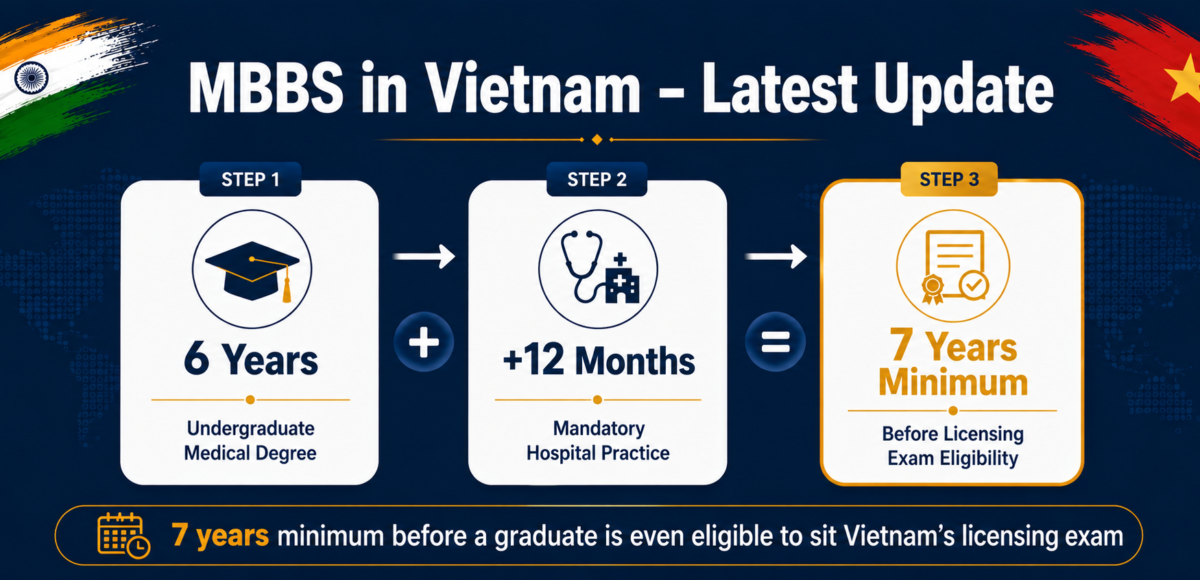
Put together, the honest timeline looks like this:
- 6 years — undergraduate medical degree
- +12 months — mandatory post-graduation hospital practice
- = 7 years minimum before a graduate is even eligible to sit Vietnam’s licensing exam
For Indian students whose ultimate goal is practicing in India rather than Vietnam, this extra year matters for life planning, financial budgeting, and comparing Vietnam honestly against other MBBS-abroad destinations — many of which advertise their own “6-year” or “5-year” numbers in similarly incomplete ways.
The Language Barrier the Brochures Don’t Emphasize
Some Vietnamese medical universities do conduct instruction in English — that part of the marketing is true. But the Embassy’s advisory draws a sharp distinction between classroom instruction and clinical reality: foreign students need to be proficient in Vietnamese to undergo practical training, because it involves direct interaction with patients who communicate in the local language.
In plain terms: you can sit through years of English-medium lectures and still find yourself unable to function in the hospital wards where the actual hands-on medical training happens, unless you’ve built genuine Vietnamese language proficiency well before reaching that stage.
The Biggest Red Flag: A New Licensing Exam From 2027 — In Vietnamese
This is arguably the most important point in the entire advisory, and the one most likely to be missing from current marketing material about MBBS in Vietnam.
According to the Embassy, starting from 2027, graduates will be required to pass a centralized government licensing exam to practice in Vietnam — and this exam will likely be conducted in the Vietnamese language. The Embassy explicitly states that students should expect to need a high level of Vietnamese language proficiency for both the mandatory hospital practice and this upcoming exam.
If you’re enrolling now with an eye toward a 2026–2032 graduation window, this is not a distant, theoretical detail — it’s a requirement you will personally face. Language preparation needs to start years before you reach your internship year, not after.
NMC Compliance Is Not Automatic — You Must Verify It Yourself
The advisory repeatedly points students back to a specific regulation: the National Medical Commission (Foreign Medical Graduate Licentiate) Regulations 2021, issued via notification dated 18 November 2021. This is the framework that determines whether a degree earned abroad will actually be recognized for practice back in India.
Critically, the Embassy does not say every Vietnamese medical university automatically satisfies this framework. Instead, it places the responsibility on the student: ascertain compliance details directly during the admission process, and separately confirm with your specific shortlisted university whether its medium of instruction, syllabus, and clinical training/internship structure meet the criteria required for eligibility under the 2021 NMC regulations.
This is a meaningfully different posture than a blanket reassurance — it’s an explicit instruction to verify before you commit, university by university.
A Pre-Enrollment Checklist Based on the Embassy’s Advisory
Before finalizing admission to any Vietnamese medical university, the advisory effectively asks you to confirm:
- Whether the specific university’s clinical practice/internship structure complies with NMC’s Foreign Medical Graduate Licentiate Regulations 2021
- What language the practical/clinical training is actually conducted in, beyond the marketed “English-medium” claim
- Your own personal readiness to build Vietnamese language proficiency well ahead of your internship and licensing-exam years
- Whether the university has published any guidance on the upcoming 2027 licensing exam and its language requirements
- That you are independently verifying these points with the university itself, not solely relying on a consultancy’s claims
Why This Advisory Matters Right Now
Vietnam has been gaining visibility as an MBBS-abroad option in recent years, with universities like Hanoi Medical University expanding English-medium seats and over a dozen accredited medical institutions marketing to international students. As with any newly popular destination, the marketing tends to move faster than the fine print — which is exactly the gap this Embassy advisory is trying to close.
It’s also worth remembering the baseline rule that applies regardless of destination country: since 2019, India’s Ministry of Health and Family Welfare has required all Indian students to qualify NEET-UG before pursuing any medical degree abroad, and only NEET-qualified candidates remain eligible to later sit India’s Foreign Medical Graduates’ Exam (FMGE) screening test. Vietnam doesn’t change that baseline requirement — it adds its own additional layer on top of it.
The Embassy’s Bottom-Line Advice
The advisory closes with a direct, unambiguous recommendation: students seeking medical admission in Vietnam are strongly advised to conduct thorough due diligence and clarify all of the above points before finalizing their enrollment. It’s a short sentence, but given everything outlined above — the real 7-year-plus timeline, the language requirements for clinical training, and an entirely new licensing exam arriving in 2027 — it’s advice worth taking seriously rather than skimming past.
Frequently Asked Questions
Q: How long does it actually take to become a licensed doctor after studying MBBS in Vietnam? A: The undergraduate programme itself is 6 years, but the Embassy’s advisory confirms an additional mandatory 12 months of hospital practice is required afterward before a graduate is even eligible to sit Vietnam’s licensing exam — making the realistic minimum timeline about 7 years.
Q: Is MBBS in Vietnam really taught in English? A: Some universities do offer English-medium instruction for lectures, but the Embassy clarifies that practical/clinical training requires Vietnamese language proficiency, since it involves direct interaction with Vietnamese-speaking patients.
Q: What is the new licensing exam starting in 2027? A: The Embassy’s advisory states that from 2027, a centralized government licensing exam will be required to practice medicine in Vietnam, and this exam will likely be conducted in the Vietnamese language.
Q: Will a Vietnam MBBS degree automatically be recognized in India? A: Not automatically. Students must independently verify that their specific university’s instruction medium, syllabus, and clinical training comply with the NMC’s Foreign Medical Graduate Licentiate Regulations 2021 before enrolling.
Q: Is NEET still required for Indian students wanting to study MBBS in Vietnam? A: Yes. India’s existing rule requiring NEET-UG qualification for any medical study abroad, in place since 2019, applies regardless of destination country, including Vietnam.
Key Takeaways
The Indian Embassy’s June 2026 advisory isn’t trying to discourage students from choosing Vietnam — it’s trying to correct a knowledge gap. “6-year MBBS” is technically true but practically incomplete: a mandatory 12-month hospital practice, a real Vietnamese-language requirement for clinical work, and a brand-new licensing exam arriving in 2027 all add weight that deserves serious consideration before enrollment. The single most actionable piece of advice in the entire notification is also the simplest — verify everything directly with your chosen university and the relevant NMC regulations before you commit, rather than relying on agent assurances alone.
This article is based on the official advisory published by the Embassy of India, Hanoi, Vietnam, dated June 5, 2026. Prospective students should refer to the Embassy’s website directly and consult the National Medical Commission’s current regulations before making enrollment decisions.
Leave a Comment